Showing posts with label Chiang Rai. Show all posts
Showing posts with label Chiang Rai. Show all posts
Thursday, 26 November 2026

Thursday, 17 November 2022
Lush lotus flowers in Northern Thai province draw tourists

Lush pink lotus flowers in one northern Thai province are drawing tourists. Bueng Boraphet, a lake and swamp in Nakhon Sawan province, currently has lotuses covering an area of over 100 rai.
A staffer at the Bueng Boraphet Wildlife Sanctuary Office said the lotuses have been blooming since early this month. The staffer said the lotuses are expected to bloom throughout swamps in early December. Bueng Boraphet is the largest freshwater swamp and lake in Thailand.
Flower lovers can hire a private boat operator to see the lotuses up close. Prices start from 600 baht per hour for a 12-seater boat.
Those interested in getting a view of the stunning lotuses can call the Bueng Boraphet Wildlife Sanctuary Office via at 056-009-717.
Nakhon Sawan isn’t the only northern Thai province where flowers are blooming. Seasonal golden flowers in Mae Hong Son province also have tourists flocking. The provincial tourism office chief said that hotels and resorts are reporting up to 75% occupancy. This, he said, is a much higher occupancy rate than the rates seen during other times of the year.
Tourists are flocking to the Khun Yuam district to gaze at the scenic Dok Bua Tong flowers, also known as Mexican sunflowers.
With cool winter weather, this is a good time to camp and go outside in Mae Hong Son and other northern Thai provinces. Last week, the glorious view of one mountain in Thailand’s iconic northern province of Chiang Mai drew hundreds of tourists.
If you’re thinking of visiting northern Thailand, Nakhon Sawan’s lotuses, Mae Hong Son’s golden flowers, and views in Chiang Mai are beautiful sites to see.
Source - The Thaiger
YOUR AFFILIATE LINK HERE


Monday, 2 December 2019
Thailand - Movie “The Cave Creates Huge Crowds at Chiang Rai’s Tham Luang Cave

12 young soccer players, members of
the Wild Boars (Mu Pa) football team, and their coach were trapped
inside the flooded cave in July last year. Their subsequent rescue,
after 17 days.
Large crowds of people are now visiting Chiang Rai’s Tham Luang cave
after the movie “The Cave” screened at theaters in Thailand. The movie
is about the dramatic rescue last year of 12 boys and their football
coach.
The movie “The Cave” is being shown at theaters nationwide.
Tham Luang cave park officials said approximately 3,000 people are
visiting the cave in Chiang Rai daily.
The Thamluang Khunnam Nangnon national park also provide a trolley service to the cave entrance.
According to park officials only 50 visitors are allowed to enter the first chamber of the cave at one time. They can also take pictures and tours are for only five minutes.
Tham Luang cave officially opened in November
The Tham Luang cave complex was officially opened for tourists in early November. Two nearby caves will be opened for nature study in the future.
The dramatic rescue of a boys soccer team from Tham Luang cave in
Chiang Rai, has also turned the area into a sprawling tourist
attraction. Drawing well over 1 million visitors since the ordeal
captured headlines worldwide last year.
12 young soccer players,
members of the Wild Boars (Mu Pa) football team, and their coach were
trapped inside the flooded cave in July last year. Their subsequent
rescue, after 17 days.
Souvenir shops have sprouted in the cave
area of Chiang Rai, in Mae Sai near the border with Myanmar. Selling
T-shirts depicting Tham Luang cave and the rescuers.
A statue of
Sgt. Maj. Saman Gunan, the retired Thai Navy SEAL who died during the
rescue mission, stands near the cave entrance.Gunman was promoted to the
rank of Lt-Commander after his death.
A nearby memorial center features a virtual cave, as well as oxygen
tanks used by the rescuers. Tourists can pose for pictures by a large
mural depicting the rescuers, titled “The Heroes.”
Source - Chiang Rai Times
Maybe not show him enough in the movie
Saturday, 2 November 2019
Thai cave reopens for visitors after Wild Boars rescue

Thailand has reopened the cave where 12 young soccer players and their coach were trapped last year in a saga that captivated the world.
The Tham Luang cave has been closed to visitors since the Wild Boars soccer team were rescued alive after nearly three weeks inside the grotto’s waterlogged corridors.
But the world-famous cave in northern Chiang Rai province was re-opened Friday, drawing some 2,000 tourists in a single day, a local conservation official told AFP.
“We have allowed visitors to see the mouth of the cave,” said Kamolchai Kotcha, director of the local conservation office that oversees the cave.
Guests are not allowed beyond the entrance for now, where they can peer into the cave opening, but officials said they were considering allowing people deeper inside after surveying the safety of the route.
Some of the rescue equipment left behind — including telephone wires, hoses and zip lines — could be exhibited inside the cave for visitors to view in the future, Kotcha said.
Photos from the opening on Friday showed tourists at the site’s entry, where last year the boys’ bikes and backpacks were found — alerting local police they were likely inside.
The Wild Boars went into Tham Luang in June 2018 for a routine hike after a football practice, but became trapped after heavy rains blocked the only route out.
Hundreds of people descended on the remote site to help save the boys, who were found — emaciated but alive — on a muddy perch deep inside the cave after nine excruciating days of searching.
The boys were sedated and fitted out in full-face breathing masks before being pulled to safety through a hazardous underwater labyrinth.
Several books deals about the drama have been inked, and the first film about the rescue premiered this month at the Busan International Film Festival in South Korea.
Source - Coconuts.co
Wednesday, 18 July 2018
#Thailand not seen as safe tourist destination until it fixes problems

TOURISM and Sport Minister Weerasak Kowsurat yesterday urged agencies to sort out a series of problems before they can send a convincing message to the world that Thailand is still a safe destination for tourists.
Weerasak was responding to the Phoenix
boat accident that killed 47 Chinese tourists earlier this month off the
southern resort island of Phuket.
There are many issues that authorities should review and rectify to help
improve tourists’ confidence in Thailand as a safe destination,
Weerasak told The Nation in an interview.
He said authorities should complete the first phase of the process by
paying all compensation that is due to the relatives of victims and
return them to their country.
.
.
Authorities should then try to figure out what happened to the boats by
retrieving the wreckage for inspection. Concerned agencies should
collect statistics nationwide about boat accidents and study
international standards for tour boats that can be compared to
Thailand.
He also urged authorities to explain that the cause of the accident was
not related to so-called zero-dollar tours or nominee ownership in
tourism. “[People] should not generalise. We should be sympathetic to
those who lost their loved ones. Money cannot bring them back,” he
said.
He also urged authorities to speed up the completion of a safety standards manual to improve confidence.
“If we can manage all the issues we then can send a single, convincing
message to the world, the Chinese, and local people and ask them to have
confidence in us,” he said. The number of Chinese tourist visitors to
Phuket has dropped sharply in the wake of the tragedy.
Source TheNation

Sunday, 15 July 2018
Thailand - Four cave footballers stateless: official

The chief of Chiang Rai’s Mae Sai district has emphasised that Thai citizenship shall be granted based on the law and there will be no exemption even for four of the footballers rescued from the cave.
“I understand that society hopes the
rescued boys get citizenship. But we have to comply with the law,” Mae
Sai district chief Somsak Khanakham said.
He spoke after news reports said some of Mu Pa Academy’s members are stateless.
The team, stranded inside the flooded Tham Luang Cave for more than two weeks, miraculously survived.
According to Somsak, someone gets Thai citizenship when he or she was born in Thailand or born to Thai parents.
Somsak said the four of 13 rescued footballers who did not have Thai
citizenship were coach Ekkapon Chantawongse, 25, and three footballers
Pornchai Khamluang, 16, Mongkol Boonpium, 13, and Adul Sam-on, 14.
According to the Mae Sai district chief, the stateless members called on
him for help with citizenship claims about two months ago. He said he
has already offered them advice.
Somsak said he heard Ekkapon already contacted the authorities but had yet to submit all the required documents.
“For children, their parents must be the one to submit the request for citizenship,” he said.
Somsak said he expected the footballers to officially seek citizenship
after they were discharged from the Chiangrai Prachanakroh Hospital.
All 13 trapped footballers are now being treated and monitored at the hospital.
Source - TheNation

Friday, 13 July 2018
#Thailand - Citizenship of three young cave survivors shines light on plight of stateless persons

THE lack of Thai citizenship of three youth footballers who were saved from the Tham Luang cave has highlighted the hidden problems of stateless people.
The Interior Ministry and the Children
and Youth Department have confirmed that three of the 13 survivors from
the Chiang Rai cave are stateless persons. Authorities have promised to
provide them legal assistance in the nationality verification process
and if there were no complications in their documents all of them will
have Thai nationality within six months.
Ekkapol Chantawong, Phonchai Khamluang, and Adul Sam-on, three survivors
from the Tham Luang cave, are among 500,000 stateless persons in
Thailand who have to endure limitations in many aspects of their life as
they are denied some rights and opportunities.
It was also disclosed that many stateless persons have to wait for a
decade to get Thai citizenship because of the slow verification process.
.
.
Surapong Kongchantuk, a prominent activist on human rights and
nationality issues, said that although the Thai government has provided
basic rights to all persons in Thailand, ensuring compulsory education
and healthcare, stateless persons still face many complications in their
lives.
“Theoretically, all people must be under the care and protection of
being a citizen of at least one state, but in reality there are more
than 500,000 persons in Thailand who do not have any nationality, even
though they are born and raised in Thailand,” Surapong said.
He said the lack of citizenship means that stateless persons are denied
access to many fundamental rights such as travelling abroad, getting
higher education or employment in some careers, so they do not have many
opportunities to improve their lives.
According to Surapong, stateless persons can ask for nationality
verification at their local administrative organisation to acquire Thai
citizenship. They must provide proof of their birth and lineage and that
they were born to a Thai national parent. Ethnic minorities born in
Thailand are eligible to get Thai nationality.
Otherwise, they can submit a bachelors degree or diploma or ask for a
special grant from the Thai government to get Thai nationality, he said.
Nevertheless, he said the procedure to verify and seek Thai nationality
is slow and complicated because local administrative organisations often
do not have enough staff to deal with the overwhelming number of
requests for nationality verification. Some people have to wait for more
than 10 years to get Thai nationality and receive a Thai citizen ID
card. Legal Status Network Foundation chairman Santiphong Moonphong also
said that due to the complications and the long period of time it takes
to get Thai nationality, many youths who do not have citizenship lose
opportunities.
Santiphong said he hoped that the nationality status of three survivors
from the Tham Luang cave would bring the problems of stateless persons
to public attention and get prompt solutions from the government.
Source - TheNation
Thursday, 12 July 2018
Thailand cave rescue to be turned into Hollywood movie

The mission to rescue 12 boys and their soccer coach from a Thai cave is to get the Hollywood treatment in a movie announced by faith-based production house Pure Flix.
Managing partner Michael Scott, who lives
in Thailand and was at the rescue site in Chiang Rai as the boys were
being pulled to safety, made the announcement late Tuesday on Twitter.
"I couldn't be more excited. This story has meant so much to me as I
have followed it in Thailand this summer," he said in a video filmed at
the scene of the flooded cave in the country's north.
"My wife actually grew up with the Thai Navy SEAL that died in the
cave. To see all that heroic bravery in the cave, and to get all the
divers out, it's just such a touching event and so personal to me."
Stunning video footage emerged Wednesday of several of the "Wild
Boars" team -- aged 11 to 16 -- being freed from the Tham Luang cave on
stretchers, ending a successful three-day rescue.
They are in good physical and mental health, say doctors, despite a
harrowing 18 days inside the dank, dark cave before a risky rescue
operation that was dubbed "Mission: Impossible".
Scott's wife has been involved with planning the funeral for Saman
Kunan, the former SEAL that died on July 6 while helping install oxygen
tanks in preparation for the extraction.
"We're here really looking at this as a movie that could inspire millions of people across the globe," Scott added.
"And we're here witnessing the events, gathering some contacts and
everything, to really tell a story about an international effort, the
entire world coming together to save (12) kids trapped in this Thai
cave."
Pure Flix co-founder David A.R. White told The Wall Street Journal
the company -- which was behind the 2014-18 "God's Not Dead" trilogy --
was talking to actors, writers and potential investors.
"Pure Flix joins the rest of the world in thanking God for answering
prayers for the successful rescue of those trapped in the cave in
Thailand," the company said in a statement.
Source - TheNation

Tuesday, 10 July 2018
#ThaiCaveRescue: Mission in third day to extract remaining four members of football team and their coach from a cave in northern Thailand

All 12 boys and their coach out of flooded cave system, Thai navy Seals confirm
All 12 of the "Wild Boars" academy team and their 25-year-old coach
have now been rescued from the Tham Luang cave in northern Thailand,
Thai Navy Seals confirm.
Four of the players and their coach have escaped on an extended operation on the third day of the rescue mission.

Final Wild Boar leaves the cave

An Australian doctor, who has been providing medical checks before the boys start their journey, and four Thai navy Seals are yet to come out of the caves.
The group were stuck in the cave since June 23 and under went a 4km long journey to escape.
The four boys and their coach who were rescued today are being taken to Chiang Rai Hospital for medical treatment.

Source -TheNation / nationmultimedia.com/
Two more Mu Pa footballers removed from Tham Luang cave Tuesday

Two more young footballers of Mu Pa Academy football club on Tuesday separately emerged from Tham Luang cave in Chiang Rai province on the day 3 of operation to remove the remaining four football players and their assistant coach.
Chief operation Narongsak Osottanakorn
said earlier that the rescue authorities expected to remove all the
stranded Mu Pa members from the cave today.
The operation that began on Sunday have already retrieved eight of the 13 Mu Pa members who got stuck in the cave since June 23.
The ninth boy emerged from the cave at 4pm while the tenth about 20 minutes later.
They received medical examinations at a field hospital erected near the cave.
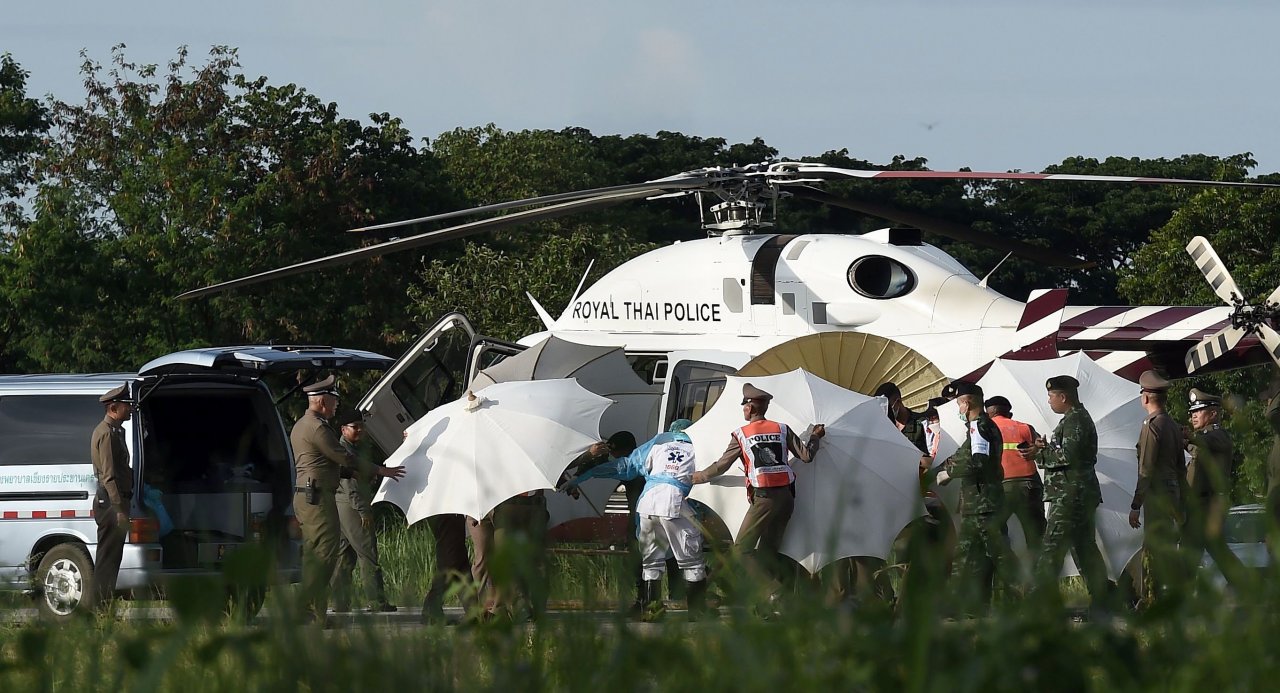
They will follow the same pattern by boarding an ambulance to board helicopter to Chiang Rai Prachanukroh Hospital.
The young Mu Pa Academy footballers, whose name have not been
revealed, were taken by ambulance from the cave in Mae Sai district
before boarding a chopper to Chiangrai Prachanukraw hospital in Muang
district. They became the second and the third to come out of the cave
on day two of the operation to evacuate the footballers and their
assistant coach from the cave, where they were stranded 15 days ago. On
Monday, four of his team members were separately extracted from the cave
and are receiving treatment at the hospital.
Source - TheNation
#Thailand - Mission Day 3 begins to evacuate final five

Efforts resumed on Tuesday morning to evacuate the remaining five Mu Pa Academy football club members from Tham Luang Cave in the hope of bringing them all to safety within hours, the mission chief said.
Narongsak Osottanakorn told reporters the
operation started at 10.08am with 19 divers assigned to extract four
young footballers and their 25-year-old assistant coach, Ekkapon
Chantawong.
He said they got an earlier start than on the previous two rescue days,
Sunday and Monday, and felt confident in the experience gained.
Despite rain overnight, the water level inside the cave was similar to that of Monday, Narongsak said.
Also to be brought out on Tuesday were the physician and three Navy SEAL
divers who had stayed with the remaining footballers on the Noen Nom
Sao ledge where they’d been found stranded.
Flash flooding trapped the group in the cave on June 23, sparking a
multinational rescue mission that had to overcome numerous difficulties,
including strong currents of murky water submerging sections of the
cave.
A pair of British cave divers found them on July 2, alive but exha
usted on a sandy ledge above the water level.
Their state of health posed a further challenge to the rescue effort, as
did the surging water levels and rough subterranean terrain.
Narongsak decided on Sunday to launch the rescue operation after being
assured the water had receded and the boys’ health was improving thanks
to nourishment given them by the SEALs team.
Narongsak said two of the boys evacuated on Sunday emerged with lung
infections, but their condition was improving with doses of antibiotics.
The eight boys undergoing treatment at Chiang Rai Prachanukroh Hospital
were in general good health, both physically and mentally, he said.
One of them has low body temperature after spending days in the cold cave but is also improving.
Source - TheNation
Thailand - Four more boys brought out of tham luang cave on 2nd successful day.
AS THE WORLD watches with awe, the dramatic rescue of the 12 boys and
their football coach from Tham Luang cave, is unfolding successfully by
the hour.
As of yesterday, at least eight of the 13 have been evacuated from the flooded Tham Luang cave in Chiang Rai province and they are now being observed at Chiangrai Prachanukroh Hospital.
The decision to evacuate the stranded 13 was made on Sunday morning and by evening four of the boys had been rescued, taking advantage of a window of opportunity. The mission plunged into the task again yesterday and managed to pull another four out by evening. Rescuers are planning to save all the remaining footballers from the Chiang Rai cave before the monsoon rains unleash their full wrath.

The drama began 17 days ago as the assistant football coach of a local football team, Mu Pa Academy Mae Sai, and 12 team members visited the mountainous region on June 23. The 13 got stranded deep in the Tham Luang cave following sudden flash floods. The children are aged between 11 and 16 years old and their coach is 25. The muddy floodwaters, the pitch darkness and thin air inside the cave hampered initial rescue efforts. The desperate rescue operation expanded rapidly as numerous rescue workers, the Royal Thai Navy’s SEALs, academics, many organisations in Thailand, and foreign experts, joined the rescue operation.
Since June 30, the floodwater level inside the cave has begun subsiding significantly thanks to the deployment of powerful pumps, diversion of water, and the gesture of farmers in the vicinity to let their fields be flooded in order to drain water from the cave.

On July 2, foreign divers found all 13 Mu Pa members alive at a dry spot about 5 kilometres from the cave’s entrance.
Serious preparations for their removal began, including a crash course in diving for the stranded survivors, with evacuations finally kicking off on Sunday.
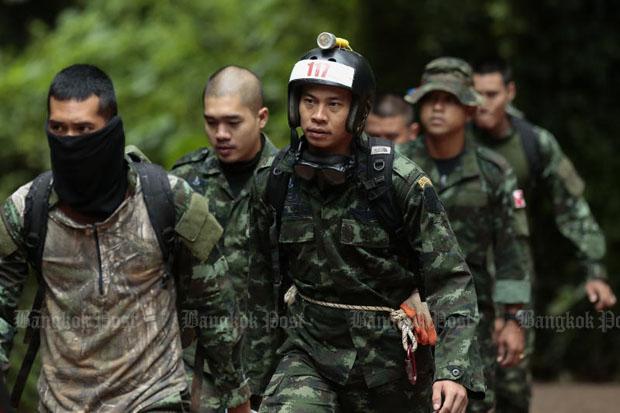
Foreign diving specialists and Thai SEALs have already successfully helped at least eight footballers brave through perilous narrow passages and tunnels in the cave, with two divers escorting each of the evacuees.
Some flooded passages within the cave are reportedly less than 40 centimetres wide, making it impossible to pass through with an oxygen tank on the back. Buoyed by Sunday’s success, the same diving evacuation team launched the second phase of the operations at about 11am yesterday.
Former Chiang Rai governor Narongsak Osottanakorn, who heads the rescue-operations command, said the divers were sufficiently rested and oxygen tanks had been replaced along their route by the support team.

Narongsak said yesterday afternoon that the prospects for their mission
were looking good. “The conditions [yesterday] are as great as on
Sunday, with regard to the floodwater level, the amount of air, and the
strength of the Mu Pa team members,” he said.
Although it has been raining in Chiang Rai province over the past few days, the floodwater level is still manageable.
The Disaster Prevention and Mitigation Department’s deputy director-general Kobchai Boonyaorana said that the floodwater level inside the cave was even lower.
“There is some rain. But water drainage at the cave has gone as well as planned,” he said. At present authorities have not revealed the identities of the evacuees out of concern for the feelings of parents whose boys are yet to come out. Narongsak only confirmed that the first four evacuees from the cave were in good physical condition.
 An ambulance exits from the Tham
Luang cave area as rescue operations continue for those still trapped
inside the cave in Khun Nam Nang Non Forest Park in the Mae Sai district
of Chiang Rai province yesterday.
While the rescue efforts have achieved incredible success, they have been beset by one fatality. Former SEAL, Petty Officer First Class Samarn Kunun, 38, died during the rescue operation last week.
Prime Minister General Prayut Chan-o-cha, who headed to Chiang Rai last night to view the progress, said HM King Maha Vajiralongkorn had provided assistance to Samarn’s family. Prayut said the King had also emphasised that the family of the deceased should receive good care from relevant organisations.
Source - TheNation
As of yesterday, at least eight of the 13 have been evacuated from the flooded Tham Luang cave in Chiang Rai province and they are now being observed at Chiangrai Prachanukroh Hospital.
The decision to evacuate the stranded 13 was made on Sunday morning and by evening four of the boys had been rescued, taking advantage of a window of opportunity. The mission plunged into the task again yesterday and managed to pull another four out by evening. Rescuers are planning to save all the remaining footballers from the Chiang Rai cave before the monsoon rains unleash their full wrath.

The drama began 17 days ago as the assistant football coach of a local football team, Mu Pa Academy Mae Sai, and 12 team members visited the mountainous region on June 23. The 13 got stranded deep in the Tham Luang cave following sudden flash floods. The children are aged between 11 and 16 years old and their coach is 25. The muddy floodwaters, the pitch darkness and thin air inside the cave hampered initial rescue efforts. The desperate rescue operation expanded rapidly as numerous rescue workers, the Royal Thai Navy’s SEALs, academics, many organisations in Thailand, and foreign experts, joined the rescue operation.
Since June 30, the floodwater level inside the cave has begun subsiding significantly thanks to the deployment of powerful pumps, diversion of water, and the gesture of farmers in the vicinity to let their fields be flooded in order to drain water from the cave.

On July 2, foreign divers found all 13 Mu Pa members alive at a dry spot about 5 kilometres from the cave’s entrance.
Serious preparations for their removal began, including a crash course in diving for the stranded survivors, with evacuations finally kicking off on Sunday.
Foreign diving specialists and Thai SEALs have already successfully helped at least eight footballers brave through perilous narrow passages and tunnels in the cave, with two divers escorting each of the evacuees.
Some flooded passages within the cave are reportedly less than 40 centimetres wide, making it impossible to pass through with an oxygen tank on the back. Buoyed by Sunday’s success, the same diving evacuation team launched the second phase of the operations at about 11am yesterday.
Former Chiang Rai governor Narongsak Osottanakorn, who heads the rescue-operations command, said the divers were sufficiently rested and oxygen tanks had been replaced along their route by the support team.
Although it has been raining in Chiang Rai province over the past few days, the floodwater level is still manageable.
The Disaster Prevention and Mitigation Department’s deputy director-general Kobchai Boonyaorana said that the floodwater level inside the cave was even lower.
“There is some rain. But water drainage at the cave has gone as well as planned,” he said. At present authorities have not revealed the identities of the evacuees out of concern for the feelings of parents whose boys are yet to come out. Narongsak only confirmed that the first four evacuees from the cave were in good physical condition.

While the rescue efforts have achieved incredible success, they have been beset by one fatality. Former SEAL, Petty Officer First Class Samarn Kunun, 38, died during the rescue operation last week.
Prime Minister General Prayut Chan-o-cha, who headed to Chiang Rai last night to view the progress, said HM King Maha Vajiralongkorn had provided assistance to Samarn’s family. Prayut said the King had also emphasised that the family of the deceased should receive good care from relevant organisations.
Source - TheNation
Monday, 9 July 2018
Thailand - Fifth footballer emerges from cave, taken to hospital by chopper

A fifth boy has emerged from the Tham Luang cave near Chiang Rai, exiting at about 5pm on Tuesday.
The young Mu Pa Academy footballer, whose
name has not been revealed, was taken by ambulance from the cave in Mae
Sai district before boarding a chopper to Chiangrai Prachanukraw
hospital in Muang district, said a source.
He was the first to come out of the cave on day two of the operation to
evacuate the footballers and their assistant coach from the cave, where
they were stranded 15 days ago.
On Monday, four of his team members were separately extracted from the cave and are receiving treatment at the hospital.
Source - TheNation / BangkokPost

#Thailand - Boys emerge from cave

Rescue mission tastes big success after circumstances were seen as most suitable to evacuate the boys all 13 stranded footballers likely to be brought out within next two days; 18 divers taking part in evacuation.
Four of the 13 young footballers trapped
in the flooded Tham Luang cave in Chiang Rai province were being
evacuated yesterday, marking a major success in the complex rescue
mission, said mission chief Governor Narongsak Osotthanakorn said at
about 8.30pm.

The rescue operation for the remaining eight boys and their 25-year-old
assistant coach will be conducted as soon as rescuers finish preparation
and deploying relevant equipment including oxygen tanks in the cave,
Narongsak said.
The process will spend about ten hours, he added.
At press time yesterday, the four boys were already receiving treatment at Chiangrai Hospital.
Earlier, the Royal Thai Air Force’s Facebook fanpage “Air Force Media by
Kawin AFU” was among the first to disclose the good news of the
evacuation operation. The page informed that two boys, who were not
identified, had been successfully brought out of the cave at around 6.10
pm, while another survivor had already reached the Navy SEALs’
operation base in the third chamber of the cave.

A military source said earlier that the first two boys who were brought
out had already been transferred to the field hospital just outside the
cave entrance for a medical check-up.
The source said the operation would be concluded in two days.

Former Chiang Rai governor Narongsak Osotanakorn, who heads the rescue
mission, told a press conference yesterday at 10am that operations had
begun to evacuate all the trapped footballers out of the flooded cave,
as all factors were suitable for the mission and all the stakeholders,
including families of the survivors, had agreed to give the go-ahead.
Under the current operation plan, each trapped footballer is being
escorted by two diving specialists through the entire length of the cave
to the entrance. Along the way, they have to climb, squeeze themselves
through narrow passages as well as dive through the heavily submerged
sections of the cave.
The first survivors were able to finally leave the dark confines of the
cave 16 days after they were all stranded. The 13 were caught in flash
floods during a visit to the cave on June 23, but they managed to find a
dry shelf where they remained without food for 10 days until they were
located by specialist divers.
“We have finally reached the highest level of preparedness to bring all
trapped survivors out of the cave, so we have to seize this perfect
opportunity when we have the most readiness to execute this daring
mission,” Narongsak said.
“This perfect situation will not last long, as within the next few days
there will be storms and heavy rains in the area that can significantly
increase flood levels inside the cave and endanger the trapped survivors
and all the officers inside.”

Disclosing details of the evacuation plan, he revealed that a total of
18 diving specialists would participate in this mission – 13 are
international specialists, while the other five are from Thailand.
They all have the necessary expertise and skills to perform evacuation
operations in difficult situations and hostile environments such as
inside the flooded cave, he assured.
The decision to go ahead with the operation comes before the arrival
today of evacuation pods built by the engineers of SpaceX as assistance
from the company’s founder Elon Musk to aid in the evacuation operation.
“The major obstacles to our operation are water and time. We have raced
against these two challenges since the first day and we still have to
race against them on this mission too, so we cannot miss this chance to
save these boys” Narongsak said.
He said once the survivors are brought out of the cave, they would be
taken into the field hospital for medical examination by 13 medical
teams, one for each survivor, in order to determine how to treat them
based on three categories: green for healthy, yellow for minor injuries,
and red for critical injuries.
7.28am Chiang Rai deputy governor invites all relatives of trapped footballers to the operation command office.
9am All reporters are told to leave the Tham Luang cave.
10am Chiang Rai former governor announces launch of rescue operation.
10am First survivor begins exit dive, with two escorts.
Noon Reporters are told to leave area around Chiang Rai Prachanukroh Hospital.
3pm Police close area around Chiangrai Prachanukroh Hospital to traffic.
5.10pm The first evacuated footballer to reach cave mouth.
7.25pm Four footballers rescued at press time.
Source - TheNation
Sunday, 8 July 2018
Thailand - Six footballers emerging in quick succession, safe and well : source

As of 7.25pm Sunday, six of the 13 Mu Pa Academy footballers trapped inside Tham Luang Cave since June 23 had been safely evacuated, a military source confirmed.
All six youths underwent medical exams, having weathered the challenging journey to the entrance of the cave from the place they’d sheltered deep inside. All were found to be in good health and responded well to queries.The first two boys were by that time already at Chiang Rai Prachanukraw Hospital, where they’ll be further monitored, and the two others were being examined at a field hospital.
Three more members of the group were in a chamber close to the cave entrance.
Source - TheNation

Mark’, 14, first the emerge from cave
The first Mu Pa Academy footballer rescued from the Chiang Rai cave has been identified as Mongkhon Bunpiem, 14.
He emerged from Tham Luang Cave at 5.10pm and was examined at a field hospital before boarding an ambulance to an airfield for the helicopter ride to Chiang Rai Prachanukraw Hospital.
Mongkhon, whose nickname is Mark, is a football academy trainee who has played football since childhood and tends to wear football jerseys all the time. His favourite team is Thai League's Muangthong United.
.
Thailand - First two footballers exit cave, getting medical check-up: military source

An ambulance that is believed to carry the first boy rescued from Tham Luang Cave in Chiang Rai leaves the cave for a hospital
The first two trapped footballers have been safely evacuated out of Tham Luang cave, a military news source has confirmed.
The Royal Thai Airforce’s Facebook
fanpage “Air Force Media by Kawin AFU” disclosed the good news that two
unidentified survivors were successfully brought out of the cave on
around 6.10pm, while another survivor had already reached the Navy
SEALs’ operation base on the third chamber of the cave.
The two survivors have already been transferred to the field hospital just outside the cave entrance for a medical check-up before being transported by separate ambulances to Chiang Rai Prachanukraw Hospital, the source said.
An evacuation operation to bring out the 13 footballers in the flooded cave kicked off on Sunday morning, with expectations that the first survivor would exit the front of the cave at around 9pm on Sunday evening.
It normally takes the Navy SEAL divers six hours to travel each way to bring supplies to the trapped footballers.
Source - The Nation
.
MORE UPDATES SOON
The two survivors have already been transferred to the field hospital just outside the cave entrance for a medical check-up before being transported by separate ambulances to Chiang Rai Prachanukraw Hospital, the source said.
An evacuation operation to bring out the 13 footballers in the flooded cave kicked off on Sunday morning, with expectations that the first survivor would exit the front of the cave at around 9pm on Sunday evening.
Source - The Nation
.
MORE UPDATES SOON
Thailand - World media moved back from cave as evacuation begins

Foreign media members on Sunday said they accepted an order by Thai authorities to move out of area outside the Tham Luang cave as evacuation of the footballers begins.
Foreign media are being evacuated four
kilometres from the cave to ensure clear access. Journalists will be
housed at the Tambon Pong Pha Administrative Organisation Office on
Phaholyothin Road.

The 12 teens and their football coach assistant have been trapped in the
flooded cave since June 23, with experts from international allies
joining with Thais to rescue the team in a race against water and time.
Local and international media have converged at the cave to keep the world up-to-date with the latest developments.
Six days after the footballers were found safe deep in the cave network
last Monday, authorities on Sunday launched the evacuation operation to
bring them out.

Spanish television reporter Biel Calderon said he didn't mind the
request that media move out of the way of officials and rescuers during
the high-risk extraction.
Calderon agreed that a large group of media could harm the efficiency of
the rescue operation and cause delays. He said he understood that there
were reasons for such a request in the life-and-death situation and
media needed to respect it.

Russian TV reporter Andrey Pashin, who had been covering the story
for the past four days from the cave entrance, said he felt positive
about the authorities regulating the large number of media in the
vicinity to ensure the rescuers are not blocked.
He hoped that, without a continuing media presence in the area,
officials could work more efficiently and more quickly rescue the
trapped youths.

Pashin said he wasn't much worried much getting film for his news
coverage, because he believed that officials were working to address the
issue. He hoped that the Thai authorities would ensure all media have
equal access to information and pictures and that any news and images
obtained by journalists would be pooled and shared among all other media
workers.

The Thai authorities on Saturday began limiting the media’s access at
the front of the cave, but some journalists had ventured under the rope
fence to report the news.
This led to an official order being issued at 7am on Sunday to reclaim
the area outside cave. Media members, along with volunteers and
officials not vital to the rescue efforts, were to be cleared from and
kept way from the area by 9am.
Many reporters negotiated to remain, while others moved as ordered to
crowd the Tambon Pong Pha Administrative Organisation Office area.
.
Thaiand - Rescue bid tipped over next few days

Leaders of the rescue effort at Tham Luang cave in Chiang Rai are
considering whether it will be practical to bring out the 12 trapped
young footballers and their coach from the flooded cave over the next few days.
It would be "favourable" to stage an evacuation before fresh rain
and a possible rise in carbon dioxide sets in, according to former
Chiang Rai governor Narongsak Osotthanakorn who has been put in
charge of the rescue operation.
"Now, water in the cave is down to satisfactory levels and the
weather is fine. The boys' health has begun to improve and they have now
learned the basics of diving," said Mr Narongsak, who is now Phayao governor.
"In the next two or three days, the conditions may be perfect to carry out the rescue plan,'' he told reporters yesterday afternoon.
The main concern is now the level of oxygen in the cave, Mr
Narongsak said, adding that more clean air has been fed into the cave
and more oxygen tanks have been brought in.
The number of rescuers operating in the cave complex will now be kept to a minimum to preserve oxygen and prevent a possible increase in carbon dioxide, Mr Narongsak said.
However, at least four rescuers will be sent in to look after the 12 boys and their coach who are sheltering on the ledge called Nern Nom Sao, he said.
Mr Narongsak added that two more British cave diving experts have arrived in Chiang Rai to support the rescue bid and another two from Britain will come today.

Subscribe to:
Posts (Atom)