Wednesday, 25 September 2019

Thomas Cook demise will affect British tourism to Thailand for the rest of 2019


British tourists have contribute between 900,000 – 1,000,000 tourists to Thailand annually for the past seven years.”

The failure of the British Thomas Cook travel business will cut the numbers of arrivals from Britain to Thailand for the remainder of this year.

Yuthasak Supasorn, governor of the Tourism Authority of Thailand says they are also assessing a drop in northern-European tourists where tourists use the services of Thomas Cook subsidiaries. The TAT will issue their new projections when the full impact of the failure of the 178 year old British travel business is assessed.
.
.
 According to the Bangkok Post, talks will include agencies such as Asian Trails, the main destination management company for Thomas Cook, and hoteliers at popular beach locations such as Phuket, Phangnga and Koh Samui, namely Dusit Thani, Anantara and Mandara.
 In 2018, 987,456 tourists from Britain visited Thailand and 600,000+ from northern-European countries. British tourists have contribute between 900,000 – 1,000,000 tourists to Thailand annually for the past seven years. The figures for the first six months of 2019 had already exceeded 500,000 visitors (584,626) and would have pushed past the million-mark for the year, but that figure is now being re-assessed.

There is currently a repatriation of existing British tourists overseas, some 150,000, back to UK shores following the collapse of the business. Confusion reigns as some hotels are charging Thomas Cook customers before they’re allowed to check-out, fearful they won’t be paid.

A prominent hotelier in Phuket, who asked not to be named, says there is still a lot of confusion about who is responsible for payments of existing customers and contractors as they work through the web of agents, insurance companies, tour companies and hotel contracts.

 Kanokkittika Kritwuttikorn, director of TAT’s Phuket office, says the failure of the British travel company won’t affect the island’s upcoming Christmas and New Year holiday season.
.
 .
“Even with Phuket the preferred destination for British tourists, the closure of Thomas Cook will not affect overall tourism in the province, especially over the upcoming high season, she told the Bangkok Post.

President of the Association of Thai Travel Agents, Vichit Prakobgosol, says the closure of Thomas Cook will “slightly affect Thai tourism”, according to the Bangkok Post.

“The fall of the firm, caused by the failure of a Brexit deal and a depreciating currency, is a wake-up call for tour operators about the impact of digital disruption as intense price wars from online travel agencies take a bite.”

Source - The Thaiger
 

Sunday, 22 September 2019

Doing #Myanmar’s (Burma) Mergui Archipelago in style

 .
Burma Boating is set to launch monthly cruises around the Mergui Archipelago in southern Myanmar, combining two of the most sought-after activities in these pristine waters – yachting and scuba diving.

The SY Dallinghoo, a 30 meter classic gaff-rigged schooner crafted by renowned US yacht designer Dudley Dix, will cast off from the port of Kawthaung in southern Myanmar once a month from November 2019 through April 2020 and traverse the Mergui Archipelago on an 8 day, 7 night sailing trip which can accommodate up to eight qualified divers.

Michael Cole, the head of Burma Boating, says that with this new Sail & Dive adventure, they wanted to offer something extraordinary.
.
“There are few, if any, undiscovered nirvanas like the Mergui Archipelago left on this planet. These cruises will provide comfort, exquisite dining, and stops at no less than five fantastic dive sites, all of which feature a kaleidoscope of coral and magnificent marine life.”
.
 The Mergui Archipelago is located in the Andaman Sea off the coast of southern Myanmar, and is home to the ethnic Moken community of fisherman, also known as “sea gypsies.”
For decades, the 800 islands, lagoons, atolls and coral reefs of the archipelago were off-limits to visitors. The islands are now accessible to limited sustainable tourism, though just five hotels have opened to date.

One of the early investors was Myanmar tourism trailblazers Memories Group, which operates a plethora of resorts and experiences around the country, including the iconic Balloons Over Bagan. Memories acquired Burma Boating in 2018, and has since built a sister resort, Awei Pila, on one of the islands in the archipelago. Awei Pila began accepting guests last December, and earlier this year opened the first scuba diving center in the region, along with PADI certification classes for beginners.
.
 .
In addition to the Sail & Dive cruises, Burma Boating offers weekly sailing and yachting trips around the archipelago – either 3N4D or 5N6D – starting October 19, 2019, through to mid-May, 2020, when monsoon season begins.

Source - The Thaiger

Friday, 20 September 2019

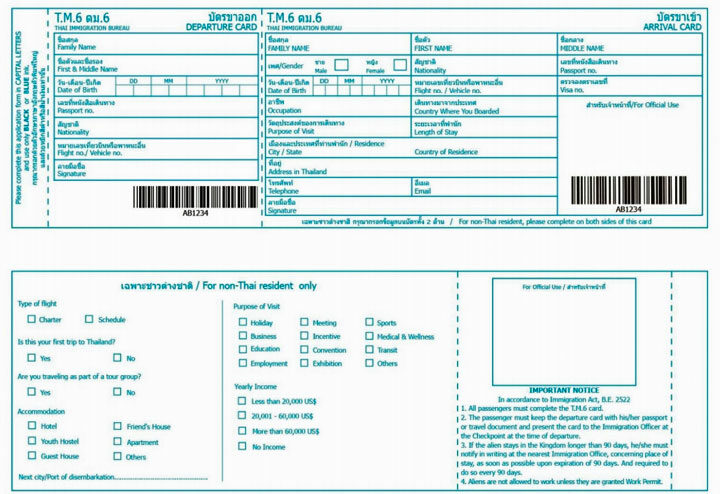
#Thailand - Immigration overhaul – TM6 disappearing and TM30 App being launched

.
“We made the decision last Friday. Within two to three months, life will be much easier for foreign tourists and expats.”

In what appears to be a major overhaul of immigration procedures, dare we say ‘modernisation’, foreign visitors will soon no longer have to fill out the “TM6” arrival forms. 

The white and blue form has been a source of confusion for decades as passengers try to fill them out on planes or in a mad rush when they arrive at immigration desks without them, for decades.

The reason for the decision to go all-digital with the arrival procedure is that, of all reasons, the storage of all the white and blue cards had become an issue.
But wait, there’s more.

Now khaosodenglish.com are reporting that Thai immigration is not only doing away with the TM6 forms, they’re about to launch a new mobile phone app to make TM30 reporting easier.

Kobsak Pootrakool, the Deputy Secretary-General to the PM, also mentioned on Tuesday that another app is being developed to allow long-stay foreigners to complete their 90 day reporting with their smart phone. And, yes, he said a smartphone App was also going to make the TM30 reporting easier.

The TM30 form, and its companion, the TM28, have been a source of expat displeasure over the past five months since the immigration department decided to enforce a little-used 1979 law that required foreigners to report their whereabouts if they had stayed overnight at an address different from their registered address.

The same applied for landlords or owners of accommodation to report foreigners staying at their venues within 24 hours. Along the way there appeared cracks in the enforcement with all sorts of variations and conundrums being thrown up at organised panel meetings and online, little of which was answered with any certainty from the Thai immigration authorities.

 Kobsak now claims that the changes are designed to attract more visitors and accommodate those already living in the kingdom.
.
 .
“We made the decision last Friday. Within two to three months, life will be much easier for foreign tourists and expats.”

“Foreigners will be able to report their whereabouts with just four clicks on their smartphone to fulfill regulations that require them to report to immigration authorities every 90 days.”

Deputy immigration commander Nattapon Sawaengkit has confirmed the move to move the TM30 reporting online when contacted for comment, but assigned another officer to explain the details, according to the khaosodenglish.com report.

 Everyone’s favourite arrival procedure, the TM6 form.
.
Source - The Thaiger

Thursday, 19 September 2019

#Thailand - “We could move the capital”, says Thai PM

.
Citing overcrowded conditions in Bangkok, Prime Minister Prayut Chan-o-cha has said moving the capital is a possibility.


He made the comment at the seminar “Connecting Thailand with the World”, hosted by the Office of the National Economics and Social Development Council in Muang Thong Thani on Wednesday (September 18), and also vowed to extend the registration deadline for low-income earners to receive state welfare.

“There are two possible approaches to moving the capital,” Prayut said. “The first is finding a city that’s neither too far nor too expensive to move to. The second is to decentralise the urban area to outer Bangkok to reduce crowding.”

The second approach would preserve Bangkok’s important landmarks, he said, while government and business facilities could be relocated to the city’s perimeter, reducing the need for so many people to travel in and out of the city centre and thus easing traffic jams.

Moving the capital is just an idea and would require extensive research as to the economic and social impacts, Prayut said, but it is a possibility under his administration.

“Past governments were never able to pull this off, fearing it would cause irreparable conflict in society,” he said. “The first priority now is to establish mutual understanding among the people to make sure they and the government are on the same page.”

Earlier this year Indonesia’s president announced that the capital of the world’s fourth-most populous country will be moved from Jakarta on the crowded main island of Java, though no new location has been chosen. 

Prayut also said at the seminar 14.6 million citizens had registered as low-income earners eligible for state welfare, though he believes the number should be higher.

“Some people missed the registration deadline, so the government will extend it indefinitely to make sure no one is left behind,” he said.

Source - The Nation

Micro-adventures in #Myanmar (Burma)


The wish to travel seems to me characteristically human: the desire to move, to satisfy your curiosity or ease your fears, to change the circumstances of your life, to be a stranger, to make a friend, to experience an exotic landscape, to risk the unknown.’ 

This country is broad and the whisper of adventure smiles coyly around most corners. Weather and politics gets in the way of travelling to many parts of the country but much of it, with a little pluck and planning, remains ripe for exploration …

 Nagaland

Even in the times of British-rule it was difficult to secure a travel permit into Nagaland, so it was naturally greeted with excitement by travelers in Myanmar when the need for such permits disappeared altogether. 

Caught between advancing British imperialism and ambitious Burmese kings, the Naga fostered a ferocious reputation as they fought to keep their autonomy. By brute force they were eventually subsumed into the British Empire. Years later, to great effect they acted as guides and scouts to the Allied Forces during the Second World War, coming to be seen by some as not savage headhunters but “extremely lovable.”

Today’s Naga Self-Administered Zone in Myanmar is a strip of land along the Indian border, with the administrative capital in Lahe, with some adventurous tourists in Myanmar making it to Lay Shi. The bold may wish to rent motorbikes; all should travel with a guide. 
.
.
Mawlaik

Recently Sampan Travel journeyed down the Chindwin River to Mawlaik. Today, it is not a town that crops up much in the newspapers nor holiday brochures however in times past it was an administrative centre of great import.

The town is peppered with colonial-era mansions, standing vacant and empty. It was also once the point at which many refugees from Yangon fled towards the Indian border as the Japanese Imperial Army invaded Burma.

British teacher U Thant Zin, a local celebrity, can still remember – and is keen to recount to those interested – of the Japanese soldiers who later committed suicide in the town as the British were returning, and the local boys who played football with their heads in the street.

A good spot for mindless wandering and settling down into tea shops. We don’t recommend the golf course. 
.
On the Chindwin.
.
 The Eng

Kyaing Tong sits in the midst of the Golden Triangle - where Myanmar meets the borders of Laos, Thailand, and China. Here it is possible to hike through fields that were not so long ago growing poppies, meeting some of the most diverse array of Myanmar ethnicities.

One of the most interesting is the Eng.

In the Eng village you will encounter errant children with pierced ears, a trusty slingshot in one hand, and wearing – if anything at all – the traditional black costume of their tribe. Their parents will likely be off working in the fields, but you can sit a while with the grandparents, many of whom will have painted their teeth black.

For a while after you leave the village the crackle and snap of twigs in the underbrush either side of the trekking track behind you will signal that you are being granted a clandestine escort out of Eng territory.


Mawlu & Henu

History wonks may travel up to Kachin State and across to Indawgyi where ‘Red Shan’ villagers on the banks of Myanmar’s largest lake may point to the place where fighter planes crashed during the Second World War.

On the way to or from Indawgyi it is worth visiting the nearby villages of Mawlu and Henu where during the Second World War, “Mad Mike” Calvert, after being parachuted in behind enemy lines, set up the Chindits base “White City.” 

Near Mawlu you can also see the field used as a landing strip and a commemorative plaque on “Pagoda Hill”. There is also here a small Chindits museum. It was here that the Calvert’s Chindits made a surprise attack on a troop of Imperial Japanese soldiers and, in Mad Mike’s own words:

 “…at the top of the hill, about fifty yards square, an extraordinary melee took place, everyone shooting, bayoneting, kicking at everyone else, rather like an officer’s guest night.”
.
.
Ye

A few hours drive south of Mawlamyine is the little town of Ye, which is as delectable and charming as its name suggests. Here is an adventure for the faint-hearted.

At Ye there is a lake which can take be circumnavigated at a meandering pace in about an hour, stopping to sit at one of the wonky “lovers’ benches” or take a cup of sweet Myanmar tea under the willows.

A walkway leads out into the centre of the lake. From here you can drop titbits into the water and watch as a writhing mass of pake fish emerge, their mouths moronic and gaping and cavernous.

For others, it may be adventure enough to slip into one of the off-piste beer stations, or sit and watch the world go by under the chinthe that guard the entrance to the central pagoda, painted in a rich scarlet. 
.
Source - MM Times

Wednesday, 18 September 2019

#Thailand scraps "arrival and departure card" for tourists and comes with app for TM30

.
A senior Thai official said yesterday that foreign tourists will soon no longer have to fill in a "departure and arrival card" (TM6) when they arrive in Thailand.

Kobsak Pootrakool, deputy sec-gen to the Prime Minister, also touted a mobile application in the works for 24-hour reporting under the TM30 form system, which has been a source of controversy in recent months. Kobsak said both changes are designed to attract more visitors and accommodate those already living in the kingdom.

“We made the decision last Friday. Within two to three months, life will be much easier [for foreign tourists and expats],” Kobsak said.

He spoke at a gala dinner to celebrate the fifth anniversary of Elite Plus Magazine at a hotel in Bangkok on Tuesday evening, where audience members included ambassadors from ten or so countries.

Explaining the government’s decision, Kobsak said arrival and departure forms for tourists, known as TM6 forms, have led to a storage problems. The government expects a total of 20 million visitors to Thailand this year.
.
“[The immigration police] have to have a huge warehouse to store these papers,” Kobsak said, adding that the police rarely look at the information in the forms, which are only stored “just in case.”

He also said the government and the immigration police agreed last Friday to streamline other procedures. Foreigners will be able to report their whereabouts with just “four clicks” on a smartphone to fulfill regulations that require them to report to immigration authorities every 90 days.

But the cherry on top seems to the revelation that the police are developing a mobile phone application for the infamous TM30 form, which requires foreign residents and their Thai landlords to file a report to the police every time the former spends a night outside their registered province.

Tourists are generally exempted from the rule, as the forms are filed by their hotels and accommodation hosts.

Deputy immigration commander Nattapon Sawaengkit confirmed the move on Wednesday when reached for comment, but assigned another officer to explain the details.

The officer, who declined to give his name, gave little information other than hinting that QR codes will likely be used.

“The apps are not finished yet. QR codes will likely be used but it’s not concrete yet. It will likely be on a smartphone,” the officer said.

Harsher enforcement of TM30 forms has recently driven expats in Thailand to air their grievances on social media. They say the 40-year-old regulation is outdated and should be amended or scrapped entirely.

The European Association for Business and Commerce, which represents European firms and businesses in Thailand, also urged reforms to TM30 in a statement to Kobsak yesterday.

Speaking to reporters on Tuesday night, Kobsak said the law will still remain on the books, but pledged to end foreigners’ discontent with the form. He also acknowledged the government should do better in attracting foreign investment and manpower.

Source - Khaosodenglish

Tuesday, 17 September 2019

Hilton to open first hotel in #Cambodia


Hilton has announced plans to enter the Kingdom’s market, with its first hotel set to come online in Phnom Penh by 2022.

The exact location of the planned Hilton hotel has not been disclosed, but reports indicate that it will be near the Central Market.

Hilton Phnom Penh will have 280 rooms and an all-day dining restaurant, lobby bar, and fitness centre, among other amenities.

To operate it, the US-based firm has signed a management agreement with real estate development group GFC Company, according to a report by TTG Asia released last week.

Paul Hutton, Hilton vice president for Southeast Asia, said they decided to expand into Cambodia because the country is primed for growth. He noted that the Kingdom experienced the third-largest increase in the number of international tourist in Asean last year, behind Vietnam and Indonesia.

“We believe the strength of Hilton brand will go a long way in helping to boost Phnom Penh as a tourism destination,” he said.

Cambodia has become an attractive destination for international hotel chains. Already several well-known international brands have a presence here: Sofitel Hotel & Resorts, Rosewood Hotels & Resorts, Park Hyatt, Raffles Hotels & Resorts, Six Senses, Hotel Emion, Ibis Hotels, Courtyard by Marriott, Alila Hotels & Resorts, Belmond, and Le Meridien.

Moreover, in July, UK-based Yoo Hotels & Resorts announced plans to build a hotel in Cambodia under its Yoo2 lifestyle brand.

According to data from the Ministry of Tourism, Cambodia welcomed 3.3 million holidaymakers during the first half of the year, an 11.2 percent hike compared to the same period in 2018.

The number of Chinese tourists, in particular, experienced strong growth. From January to June, 1.2 million Chinese nationals visited the country, a 38 percent increase.
 
Source - Khmer Times