
Showing posts with label Holidays. Show all posts
Showing posts with label Holidays. Show all posts
Wednesday, 18 November 2026
Thailand’s Visitor Numbers Rise, But Chinese Arrivals Fall
BANGKOK — International tourist arrivals in Thailand rose 4.26% during the week of Nov. 8–14, reaching 663,520 visitors even as arrivals from China fell 13.93%, according to data released by the Ministry of Tourism and Sports. A 42.40% post-Diwali surge in travelers from India offset the Chinese downturn and pushed total weekly traffic up by 27,088 visitors over the prior week.


Wednesday, 11 November 2026
As Chinese tourists stay away, Thailand vows measures to address safety concerns

Thailand is strengthening tourist safety measures and working with China to restore visitor confidence after warnings about safety and fraudulent job recruitment schemes kept away Chinese arrivals.
The two countries plan to establish a joint working group to protect tourists, exchange information and coordinate assistance, Tourism and Sports Minister Surasak Phancharoenworakul said, as cited by The Nation Thailand.
He discussed the proposed cooperation with Chinese ambassador to Thailand, Zhang Jianwei, on Nov. 5, following an embassy advisory issued in October warning Chinese citizens traveling to Thailand about fraudulent job offers.
"China has made clear that it does not support Chinese nationals who break the law in Thailand and wants Thailand to take firm action," he said.

China is willing to share information about individuals to help Thai authorities distinguish between Chinese nationals involved in illegal activities from legitimate tourists, he added.
The tourism ministry will also work with security agencies to strengthen checkpoints, patrols, and law enforcement in vulnerable areas as part of efforts to improve visitor safety and restore confidence.
Chinese arrivals fell by 13.57% year-on-year in October to 308,942, the first decline since February, interrupting a recovery in visitor confidence following safety concerns, Bangkok Post reported.
The government led by Prime Minister Anutin Charnvirakul will use the Asia-Pacific Economic Cooperation Economic Leaders' Meeting in Shenzhen, China, on Nov. 18–19 to highlight Thailand's commitment to protecting international visitors, Phancharoenworakul added.
Thailand received 25.4 million foreign visitors between January and October, down 4.59% from the same period in 2025, according to the Ministry of Tourism and Sports.
China remained the largest source of international tourists, with 4.2 million arrivals during the period.
Thailand targets 5.1–5.5 million Chinese visitors during the full year.
Source: VNExpress
Declining number of European and Chinese tourists threatens high season in Thailand

BANGKOK — Thailand is heading for a difficult winter season due to a simultaneous decline in European and Chinese visitors. Thailand's hospitality sector fears for occupancy levels during peak season. Geopolitical tensions in the Middle East are hampering air travel from Europe, while security concerns surrounding cross-border crime are reducing demand from China.
In destinations such as Pattaya, entrepreneurs see the number of European tourists dropping by 20 to 30 percent compared to last year, due to higher air fares and changed flight schedules. European travelers are highly dependent on transfer hubs such as Dubai, Doha and Abu Dhabi. Military escalations around the Strait of Hormuz lead to higher fuel costs, diversions and less consumer confidence. The influx of Russian visitors remains stable, but cannot compensate for the loss of the broader European market.
The Chinese market has also seen a sharp decline: the daily number of arrivals fell from an average of 10,000 to around 7,000, after warnings about criminal 'scam centers' in neighboring Myanmar. The Thai Ministry of Tourism consulted with the Chinese embassy on this matter, which led to a joint working group on information exchange and security.
The government is considering additional marketing support for airlines, and industry organizations are calling for 300 additional charter flights. Despite the Tourism Authority of Thailand's goal of welcoming more than 10 million long-distance visitors, the Kasikorn Research Center expects a 4.9 percent decline in foreign arrivals for the whole of 2026, putting significant economic pressure on hospitality, transport and entertainment.
Source: ThaiExaminer
Monday, 13 February 2023
Suvarnabhumi Improves Services Amid Thailand’s Tourism Rebound

BANGKOK (NNT) - The Ministry of Transport has instructed Suvarnabhumi Airport to urgently address the issue of long immigration queues and wait times at baggage carousels in order to better facilitate the entry of international travelers amid Thailand’s tourism rebound.
Serving as the country’s main port of international arrivals, Suvarnabhumi Airport last month saw a total of 4.3 million passengers at an average of 138,287 daily passengers, representing 317% year-on-year growth.
The airport in January 2023 served 25,690 flights at a daily average of 829 flights. Some 2,000 of the flights that month - or around 80 flights per day - were from China, bringing in a total of 255,000 arrivals, or around 11,000 passengers a day.
The surge in arriving passengers has caused some issues at the airport, particularly congestion at passport control and long processing periods for baggage. Transport Minister Saksayam Chidchob said that while these issues have already been addressed, more work needs to be carried out to ensure the airport’s capacity for future growth.
The Ministry of Transport has ordered Airports of Thailand (AOT) to add 60 additional immigration counters at the airport’s passport control areas. This expansion, which is in the process of selecting contractors, is expected to expand the processing capacity at passport control to 3,000 people per hour.
On the baggage handling front, AOT has instructed the two ground-handling companies to increase the number of staff members and equipment in order to accommodate more flights. Some airlines have received temporary authorization to manage their own ground-handling at the airport, in an effort to help reduce delays.
The AOT is also in the process of selecting a third ground-handling company to serve flights at the airport, as this would enable the airport to more sustainably increase its growth capacity for flights and passengers.
Sourse - ASIAN NOW
Tuesday, 20 December 2022
#Thailand to open all land border crossings next year

Thailand is planning to open all land border crossings with neighbouring countries next year. The move is reportedly part of an effort to facilitate the transportation of goods to help restart one aspect of the economy. The Department of Foreign Trade says it will negotiate with Laos, Myanmar, Cambodia and Malaysia to reopen all 97 land borders and hold trade fairs throughout several locations next year.
According to the National News Bureau of Thailand, the DFT Director General says the department will remain committed to facilitating exports through the modernisation of specific laws. Such modernisation includes upgrading department services like permit extensions, geographical indication documents and exporter registrations.
Last year, Thailand brought in around 1 trillion baht in revenue from border trading but trade with Singapore, Vietnam and China decreased as more exporters chose air shipping.
Thai farm products including rice will be promoted at events by the DFT both at home markets and abroad. Thai rice exports exceeded 8.5 million tonnes this year, surpassing the target of 7.5 million tonnes.
Source - The Thaiger
YOUR AFFILIATE / REFERRAL LINK HERE
.
Friday, 16 December 2022
Russians still biggest tourist group in Phuket, peak expected during holidays

Russians remain Phuket’s biggest tourist group, and the island resort’s tourism is expected to peak during the holidays, according to the president of the Southern Thai Hotels Association, Sueksit Suwannadissakun, who believes the peak of tourism High Season will be between December 24 to January 5.
About 57% of hotels in the island province reopened in October, jumping to 70% in November, according to Sueksit. He said the association expects that during Christmas and New Year, 80% of Phuket hotels will be opened. Sueksit told The Phuket Express…
“The top tourists are now Russians which is about 25% of total visitors, secondly followed by Indians at 12%, and finally Singaporeans and Australians at 6%. These four groups of tourists are almost half of the overall tourism market in Phuket.”
Sueksit added that most other tourists in Phuket are Europeans coming to Thailand for the warm winter here.
In November, Phuket saw 55,097 Russian tourists arriving on its shores. The second largest tourist group in Phuket that month came from India, with 26,525 travellers, according to Phuket Immigration.
The recent swarm of Russian tourists in Thailand has taken the country’s tourism forces completely by surprise. Despite the ongoing conflict between Russia and Ukraine, the Russian tourism market has returned much quicker than expected, according to the president of the Association of Thai Travel Agents (ATTA) last month.
Chartered flights to Phuket and Pattaya are being filled by Russian tourists. Less than two weeks after Russian airlines made their triumphant return to Phuket, Aeroflot announced an increase in direct flights to the island. The flagship airline of Russia made known on November 12 that it would be adding 14 new flights a week from Russia to Phuket.
As of October 26, Thailand witnessed 7,349,843 international tourists arrive at its airports. According to the governor of the Tourism Authority of Thailand (TAT), Thailand is on course to attract around 11 million tourists this year.
Source - The Thaiger
YOUR AFFILIATE / REFERRAL LINK HERE
Monday, 28 November 2022
Bangkok - Why aren’t tourists returning to Khao San Road?

The past few years have been dark for tourism in Thailand and around the world. The Covid-19 global pandemic closed borders and killed tourism in so many crucial areas. Khao San Road, the vibrant, bustling backpacker haven of Thailand’s capital city of Bangkok quickly fell into a desolate ghost town. Now, the last pandemic restrictions have been lifted, and the government is constantly reporting floods of international tourists bringing Thailand back to life. But vendors on Khao San Road say they’re just not seeing the tourism numbers that were predicted even as all Covid restrictions have been lifted.
The popular tourist neighbourhood took a beating when restrictions started rolling out. Bars were among the first businesses to close, and authorities did everything they could to prevent poorly ventilated crowded places to operate in the face of airborne disease. So Khao San Road – packed densely full of eating and drinking backpackers and cafes, street bars, and shops crowding them for their business – was a prime target to be shut down for most of the pandemic.
The Bangkok Post recently interviewed vendors on the street now though, and they all say that they have not seen the crowds come surging back even as the last of the pandemic restrictions were lifted last month. They are calling on the government the launch tourism campaigns luring international travellers back to Khao San Road and the surrounding area. One vendor selling clothing in a street stall appealed to foreigners to return.
“We’re still waiting for them…. come back to Khao San. We still need all of you. There are few foreign customers today. Before the pandemic, I earned around 5,000–6,000 baht a day, but now I earn just 1,000–2,000 baht a day. After the pandemic, most foreign tourists are more careful with spending. It’s even harder to close a sale each time. They want me to give them a big discount.”
Vendors called on the Bangkok Metropolitan Administration and the Tourism Authority of Thailand to focus their efforts on raising awareness of unrestricted travel in Thailand. They also want help promoting that while many costs have skyrocketed in the industry, accommodation is still affordable on Khao San Road, and the area is linked to plenty of tourist attractions. The road lies just a short walk from the Grand Palace and Wat Phra Kaeo. Great shopping, dining, and other attractions are just a short hop away.
A pad Thai seller said she was happy to be back on Khao San Road for the first time since the pandemic, even though she is earning half as much as before. But she called on the government to support the area, promoting holidays and events. Before the coronavirus, Khao San was packed for every special event or holiday.
“We have not celebrated the new year and the Songkran festivals together for two years. So, the government must organise these two big events next year and should regularly promote events every holiday to encourage tourists to visit.”
Source - The Thaiger
YOUR AFFILIATE / REFERRAL LINK HERE
Wednesday, 30 March 2022
Tourism Council of #Thailand calls for PCR testing on arrival to be dropped asap

Tourism businesses in Thailand are struggling to survive and barriers to increasing the number of foreign visitors to the kingdom must be removed immediately. That’s the view of Chamnan Srisawat from the Tourism Council of Thailand, who says the Omicron variant, coupled with Russia’s war on Ukraine, has dealt a double blow to the sector.
“Tourism operators are still struggling to maintain business as the number of tourists has yet to fully rebound due to the current travel rules. This obstacle needs to be removed before more operators collapse.”
The Bangkok Post reports on the findings of a recent TCT poll that surveyed 200 overseas travellers in the period from February 20 to March 10. Of those questioned, 71% agreed the process around the PCR test on arrival is cumbersome.
Chamnan says if Thailand’s tourism industry is to survive, it needs to retain 40% of its 2019 level of business this year. That’s 1.2 trillion baht in revenue, from 16 million tourists and 75 million domestic trips. He adds that in order to achieve this, the onerous Thailand Pass registration process and PCR testing on arrival needs to go as soon as possible.
According to the Bangkok Post report, TCT’s tourism confidence index during the first quarter of 2022 stood at 44, which was a big improvement from 36 during the same period in 2021. However, it’s still down from 47 during the last quarter of 2021. Any reading below 100 indicates weak tourism confidence among those in the sector.
740 tourism operators participated in the survey and its findings show that confidence is lowest among nightlife operators, who have been the most severely affected by Covid restrictions. The confidence level among those businesses is at 20, down from 41 during the same period in 2021.
According to Chamnan, 78% of tourism operators are struggling to increase their revenue, with 45% reporting a decrease and 33% only just managing to maintain the same level of income as during the last quarter of 2021. Entertainment venues were the worst affected, with around 44% planning to lay off workers in the second quarter of this year. They were followed by spa businesses, massage parlours, and tour operators.
Source - Bangkok Post / The Thaiger
VISA AGENT / How to register for: THAI PASS - TEST & GO
Tuesday, 29 March 2022
Lufthansa reopens Bangkok Munich route

Lufthansa is offering customers daily flights between Bangkok and the Bavarian capitol Munich beginning with this year’s summer schedule on 27 March. These flights replace service to Frankfurt during the winter.
The initial Lufthansa flight schedule is as follows:
* Bangkok – Munich / Flight LH773 / departure: 11 p.m. local time, arrival: 5.20 a.m. local time
* Munich – Bangkok / Flight LH772 / departure: 10:45 p.m. local time, arrival: 2:10 p.m. Bangkok local time
The aircraft operating these services is the most modern in the world: the Airbus A350-900 that has set high standards in fuel-efficiency and passenger comfort. It offers 48 lie flat seats in Business Class, 21 in Premium Economy and 224 Economy Class seats.
Munich – Bangkok, however, is not the only service Lufthansa Group, Europe’s largest airline group, will offer Thai customers. The Group’s other premium carriers, SWISS and Austrian Airlines, will also connect Thailand with the heart of Europe. In the summer schedule, SWISS will fly six times weekly between Bangkok and Zurich while Austrian Airlines will fly daily between Bangkok and Vienna.
READ MORE - Bangkok-Jack
VISA AGENT / How to register for: THAI PASS - TEST & GO
Sunday, 27 February 2022
Russian flights keep arriving in Thailand, for now
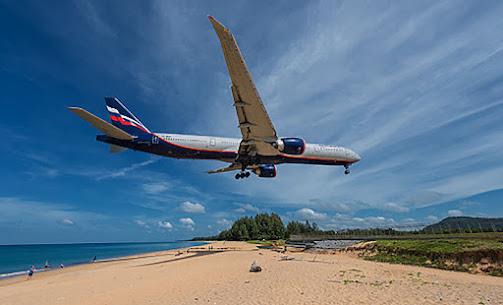
Aeroflot, Ural Airlines and S7 Airline planes are still arriving on schedule in Thailand today as nothing has changed, thus far, as flights into Thai airports from Russia are concerned.
But Thailand’s tourism tzars continue to monitor Russia’s invasion of Ukraine, as the world looks to ways of pressuring and sanctioning Russia, including access to its airlines across the world.
At this stage there has been no official comments coming from the Thai government about the invasion of Ukraine or any Thai reaction to the conflict, beyond assuring Thais in Ukraine that they will be evacuated.
Russian arrivals ranked Number One in Thailand during the first 22 days of the resumption of the Test & Go program, from February 1 – 22. 13,063 Russian tourists arrived in Thailand over that time, followed by 10,412 visitors from Germany and 8,900 from France.
Both Russia and China were two of Thailand’s top feeder markets before 2020, the start of the Covid-19 pandemic. The Chinese will remain notably absent until, probably, later in 2022. Now the Russian tourist tap may be switched off as well.
But with the developing conflict in Ukraine, the Russian Ruble has dropped around 18% against the Thai baht, since February 9, putting further pressure on Russian tourists travelling to Thailand at this time. Despite fluctuations, the Ruble is again on another downward trend versus most international currencies since the invasion on Thursday.
The other major threat to tourism arrivals, from just about anywhere in the world, is the huge surge in oil prices which will eventually hit plane ticket prices, including domestic flights within Thailand.
Oil prices briefly topped US$100 a barrel on Thursday reflecting panic in the first hours of the Russian invasion, the first time they’ve surpassed the US$100 mark since 2014, but they fallen back slightly since. In the 2020’s the average price was about US$39 a barrel.
So far there hasn’t been any immediate, or tangible, increase in flight prices inside Thailand, or internationally, but aviation experts believe that it’s just a matter of time.
They note that airlines with the youngest fleets, and the most fuel-efficient aircraft, will suffer the least as a direct result of the rising oil and, consequently, av-gas prices.
Thai Airways still has Thailand’s oldest fleet of aircraft.
Following this week’s alteration of Test & Go program requirements, removing the pre-paid PCR test and night of accommodation on Day 5 (and replacing it with a self-ATK test to be uploaded onto the Mor Phrom App), tourism operators expect an uptick of new bookings, but fresh applications for the Thailand Pass remain under original predictions.
Tourism operators also believe that nurturing the newer feeder markets, of India and Saudi Arabia, will play a crucial role, both during the ongoing tensions in Central Europe, and the onset of Thailand’s low season.
Then there’s the surge in cases of Omicron in Thailand and how the government will react to that over the coming month.
Source - The Thaiger
VISA AGENT / How to register for: THAI PASS
Thursday, 24 February 2022
Thailand Eases Entry Rules to Reboot Tourism

Thailand will further relax entry rules for foreign visitors starting next month, bowing to demand from the local tourism industry to lower costs as more countries ease border controls to lure holidaymakers.
Vaccinated visitors to the Southeast Asian nation won’t be required to undergo a mandatory polymerase chain reaction test on the fifth day of the arrival starting March 1.
Instead, they can do a self antigen test, scrapping the requirement to have a confirmed hotel reservation for the test.
The Center for Covid-19 Situation Administration, Thailand’s main virus task force chaired by Prime Minister Prayuth Chan-Ocha, also lowered the minimum medical insurance coverage for visitors to $20,000 from $50,000.
Thailand is making it easier for travelers to its famed beaches, Buddhist temples and national parks after nearly two years of tight border curbs decimated its tourism industry.
While the nation is battling a spike in omicron-led Covid cases, low mortality rate compared to the peak delta wave means healthcare facilities can cope up with the outbreak, Taweesilp Visanuyothin, a spokesman for the task force, said at a briefing Wednesday.
Thailand saw its Covid cases jump to 21,232 on Wednesday, a six-month high, but the deaths stood at 39, compared with more than 300 a day during the peak of the delta wave in August.
The baht rallied as much as 0.4% on expectation easier visa rules will boost the country’s current-account surplus. The currency traded at 32.329 to a U.S. dollar, extending gains this year to 3.3%.
Tourism-reliant Thailand has been experimenting with several plans in recent month to try to revive the travel sector that used to contribute to about one-fifth of its economy, with 40 million foreign tourists generating more than $60 billion in 2019.
The country has cleared about 302,000 visitors under its so-called “Test & Go” program since it was reopened for a second time on Feb. 1, according to Taweesilp.
Bangkok, the nation’s capital city, eastern province Chonburi and resort island Phuket received the most travelers under the plan, he said.
Source - BangkokJack
VISA AGENT / How to register for: THAI PASS
Sunday, 2 January 2022
Tourism Ministry Launches ‘Thailand Trusted Destination’ Campaign

Krabi (NNT) - The Ministry of Tourism and Sports has launched the “Thailand Trusted Destination” campaign to raise the nation’s tourism standards. Visitors can now look for venues and attractions bearing the campaign’s dancing elephant logo. The logo certifies attractions that meet the standards promoted by the ministry.
The Department of Tourism under the Ministry of Tourism and Sports took business operators on a field trip to Krabi province to observe venues and attractions certified under the Thailand Trusted Destination campaign.
The campaign was introduced as an incentive for business owners to improve their services and boost confidence among tourists. Participating venues will be granted the dancing elephant logo, which represents cleanliness, safety, fairness, good management, and green practices.
During the field trip, business operators visited Krabi International Airport, which has been certified for toilet cleanliness; Laemsak Community which was certified as a community-based tourism attraction with historical value; and Than Bok Khorani National Park, which has been certified for its success in environmental conservation and tourist safety.
Source - ASIAN NOW
VISA AGENT / How to register for: THAI PASS
.
Monday, 27 December 2021
Thailand – the 17th anniversary of the Indian Ocean Tsunami

A powerful underwater earthquake rumbled off the coast of northern coast of Sumatra island, Indonesia, at 7:59am local time, setting off a series of underwater shockwaves that would eventually be felt right around the rim of the Indian Ocean.
It was the Boxing Day Tsunami (or Indian Ocean Tsunami, or Asian Tsunami) and it started affecting the shorelines around the Indian Ocean, first in the Indonesian region of Aceh, and then Thailand’s southern Andaman Sea shores not long after on Sunday morning, December 26, 2004.
The magnitude 9.1 quake ruptured a 1,500-kilometre stretch of fault line where the Indian and Australian tectonic plates meet. The heavier ocean plate slipped under a lighter continental plate. The effect, and location, proved deadly for anyone living along the shorelines of the Indian Ocean.
Within 20 minutes of the earthquake, the first of several 22 – 33 metre high waves hit the shoreline of Banda Aceh, killing 100,000+ people. Then, in succession, waves rolled over coastlines in Thailand, India and Sri Lanka, killing tens of thousands more. 8 hours later and 8,000 kilometres from its Asian epicentre, the tsunami claimed its final casualties on the coast of South Africa. In all, 230,000 – 250,000 people died, or were never found, making it one of the deadliest natural disasters in recorded history.
The tsunami reached Phuket and coastal provinces nearby around 10am, causing uncountable losses, devastating the low-lying coastal towns of Patong, Kamala and Koh Phi Phi. Some of the other island beaches had less damage with steep shoreline breaks that took a lot of the initial energy out of the waves.
Just north of Phuket, in Khao Lak, they had a very gentle sloping coastline, so the waves travelled swiftly and reached into areas up to kilometre inshore. Poom Jensen, the grandson of the late King Bhumibol Adulyadej, and a nephew of the current Thai King, was killed whilst his family was holidaying at Khao Lak.
3 large waves that swept inland along parts of the Andaman Coast on that day.
Official Thai government statistics estimate 4,812 souls were lost to the waves on December 26, 2004, with another 8,457 injured and 4,499 missing, presumed dead.
While confirmed deaths in Phuket officially numbered only 259, another 700 remained listed as missing.
At the time the popular tourist communities were able to clean up and re-open some of their hotels within weeks. A year later much of the damage had been cleaned up and repaired. NGOs rushed to Thailand to assist in the clean up and identification process of the dead.
The tsunami and its aftermath were responsible for immense destruction and loss around the rim of the Indian Ocean. Some locations reported that the waves had reached a height of 20 metres, or more, when they hit the shoreline. In Aceh, up to 30 metres. Indonesia, Sri Lanka, India, Maldives and Thailand sustaining massive damage.
17 years after the Indian Ocean tsunami swept ashore, a container at the Takua Pa police station in Phang Nga, southern Thailand, still contains personal items from the hundreds of victims whose remains are unlikely to ever be given a name.
Wallets, documents, keys, electronic items, all labeled and catalogued as evidence, await positive identification. Nearby a graveyard contains 340 bodies buried in unmarked graves but police hope that, if people came forward to identify some of the items, there is still hope that some of the bodies could rest in peace with a name attached.
Source - The Thaiger
VISA AGENT / How to register for: THAI PASS
.
Sunday, 12 December 2021
Thailand set to approve Special Tourist Visa for digital nomads

Thailand is preparing to accommodate an increasing number of “digital nomads” with eyes on Bangkok, Phuket and Chiang Mai as work and vacation destinations.
Spokesperson for the Prime Minister’s Office Thanakorn Wangboonkongchana said the three cities were ranked by Germany-based vacation search engine company Holidu on its list of the best ‘workation’ cities in 2021. One of the groups included in the survey comprised workers who travel to different locations, using mobile devices to perform their jobs remotely at coffee shops or public libraries.
A recent survey by the Adventure Travel Trade Association found Thailand to be among the most popular destinations for these digital nomads. Respondents cited blazing internet speeds, affordable living costs, and scenic tourist attractions are some of the factors that attracted them to the Kingdom, especially with so many others now working remotely due to the global pandemic.
The spokesperson said the government is working to accommodate the increasing numbers of digital nomads by approving a Special Tourist Visa (STV) that allows foreigners to stay for 90 days.
The visa can be extended twice, meaning tourists can stay up to 270 days at a time. The government hopes that STVs will help revitalize the tourism industry under effective COVID-19 control and prevention measures.
Meanwhile, Prime Minister Gen Prayut Chan-o-cha has commended relevant agencies and the Thai people for making Thailand one of the best destinations for travelers. He also assured that the government would be ready to listen to all constructive feedback in order to draft policies that benefit everyone.
Source - ASIAN NOW
VISA AGENT / How to register for: THAI PASS
.
Saturday, 13 November 2021
Thai Government considers easing entry rules, antigen testing may replace PCR test

In anticipation of more international arrivals in the coming months, the Thai government is reviewing current entry requirements. According to a Bangkok Post report, officials may replace the PCR test with antigen test kits and rules could be relaxed for people unfortunate enough to have sat near an infected passenger during their flight. Any amendment of the current rules would need approval from the national communicable disease control committee and the CCSA. The PM will chair a CCSA meeting later today.
Yuthasak Supasorn from the Tourism Authority of Thailand says the time it takes to get results from PCR testing could see the method replaced with ATKs in order to better manage the flow of arrivals during the coming months. He adds that the CCSA will also review the rule that currently requires travellers who sat 2 rows behind or in front of an infected passenger to be moved to quarantine facilities. According to the Bangkok Post report, officials are considering a change that would mean only people who sat next to an infected passenger would be quarantined, meaning a maximum of 2 people for each patient.
Other proposed changes include ditching mandatory hospitalisation for infected arrivals who are asymptomatic or only have mild symptoms. Instead, they would be given a choice of alternative quarantine or a “hospitel”, with the period of stay reduced from 14 days to 10. As of November 9, just 28 of the 28,021 travellers who entered the country following the November 1 re-opening have tested positive for Covid-19.
Marisa Sukosol Nunbhakdi from the Thai Hotels Association says that if the number of foreign arrivals continues to rise, problems such as congestion at the airport and insufficient airport transfer vehicles could arise. Currently, only transportation services with the SHA Plus accreditation can transfer arriving passengers to their accommodation.
She adds that while SHA Plus hotels in Bangkok are benefiting from the mandatory 1-night stay to await Covid test results, hotels in Pattaya and Hua Hin continue to struggle, with fewer guests than expected. Ditching the PCR test in favour of antigen testing would mean tourists would be free to immediately travel to the destination of their choice. The current rules require them to stay at a hotel that is within a 2-hour drive of their arrival airport until they receive a negative result from their PCR test.
Cource - The Thaiger
VISA AGENT / How to register for: THAI PASS
.
Wednesday, 10 November 2021
Tourist faces huge bill, separation from family after testing positive on arrival in Thailand

A tourist has revealed his anguish at the possibility of being hit with a large bill after falling foul of Thailand’s test on arrival policy.
The tourist, named only as Kirovs, told blogger Richard Barrow how he had arrived in Thailand on Nov 7.
Kirovs tested positive on arrival in Thailand and was sent to hospital, where he will have to stay for at least 10 days, despite not having any symptoms.
His family - wife and two children - were sent to hotel quarantine and are due to take another test on day 3 or 4. If they test negative they may be able to continue on their holiday without him.
Kirovs estimates he may have to pay 350,000 Baht towards hospital and quarantine fees if his insurance provider won’t cover it.
“I knew that I was taking a gamble when I chose to buy plane tickets as soon as the Thailand reopening was announced,” Kirovs told Richard.
“We lost that bet.”
Richard Barrow also highlighted the plight of a man named James who found himself in an equally unfortunate situation after arriving in Thailand.
Despite himself testing negative, James shared a car from the airport with someone who tested positive, which for James meant he also had to go to hotel quarantine.
James said he was travelling to Thailand to be reunited with his wife. He was travelling with his friend who was visiting his girlfriend. It was his friend who tested positive.
“Upon arriving at the hotel, we both were tested at 2:30 p.m. and sent to our separate rooms. At midnight we both received a message, James said.
“His said that he had tested positive and will be transferred to hospital, and mine said that mine is negative, but I’d need to stay in quarantine for 14 days”.
James said both he and his friend were not showing any symptoms.
While the chances of testing positive on arrival in Thailand are small, it is perhaps a risk simply not worth taking for some tourists.
To date, approximately 25,000 tourists have entered Thailand since the country reopened to tourists on Nov 1.
Only 26 tourists have tested positive.
However, the issue is compounded by the fact that there is next to no official information about the risks of travelling to Thailand and testing positive on arrival.
Despite the myriad of infographics, Facebook posts and tweets from the Tourism Authority of Thailand and other related agencies on the requirements for foreigners to enter Thailand, there is very little about what a positive test on arrival could mean for foreigners, especially those travelling in groups, as a family or with young children.
Information regarding the impact of a positive test on arrival could (and should) be clearly publicised on the Thailand Pass website, which foreigners are required to upload documents to prior to travelling to Thailand.
Foreigners should also be urged to check with their insurance companies if their policy covers them for quarantine and other expenses in the event of a positive test.
Source - ASIAN NOW
VISA AGENT / How to register for: THAI PASS
Sunday, 31 October 2021
Thailand increases number of 'low risk' countries from 46 to 63

Thailand has increased the number of countries and regions it will allow fully vaccinated visitors without quarantine under its 'Test & Go' policy.
Late on Saturday (Oct 30), the Ministry of Foreign Affairs announced that its list of 'low risk' countries and territories had been increased from 46 to 63.
New additions to the list include India, Luxembourg, Vietnam, Taiwan and the Philippines, among others.
The news comes as the Indian community in Thailand last week called on the Thai government to allow Indians to be able to visit Thailand from November 1.
Satish Sehgal, chairman of the India-Thai businessmen association, said Indians should be included in the 'low risk' list as Indian tourists are amongst the top 5 spenders in Thailand, visiting the country for tourism, weddings and business.
Thailand is the top overseas wedding destination for wealthy Indians.
In 2019, approximately 2 million Indian tourists visited Thailand generating 80 billion Baht in tourism revenue,
On Monday (Nov 1), Thailand officially reopens to international foreign tourists for the first time since the start of the pandemic.
Source - ASIAN NOW
VISA AGENT / How to register for: THAI PASS


Friday, 29 October 2021
Entry requirements for international arrivals starting November 1

The Thailand Pass is set to launch in 5 days, aiming to ease the process to get approval to enter Thailand. The entry requirements for international travellers still require some hoops, but the government hopes this streamlining will help welcome back much-needed tourism to the country.
The website for the Thailand Pass has been created at tp.consular.go.th but it is not active yet, displaying a message that registration begins at 9 am on November 1. All currently issued certificates of entry will be honoured and travellers can request refunds from their hotels for the cost of lifted requirements.
Thailand Pass will open for registration on 1 November 2021 at 09.00 hrs. We recommend you to register for Thailand’s new electronic entry document (Thailand Pass QR code) at least 7 days prior to your travel date. For travellers who have been granted COE (Certificate of Entry) and will arrive in Thailand from 1 November 2021 onwards, the COE remains valid for entering Thailand. Travellers can update the approved COE with the revised terms and condition of stay complying with new entry regulations by downloading the new COE at the registration website (coethailand.mfa.go.th) or the link from your COE approval notification email.
The Department of Consular Affairs and the Ministry of Foreign Affairs have prepared an infographic outlining the 5 steps of the entry requirements for Thailand starting November 1.
1/ PREPARE: Required documents
1/ Passport
2/ Thai visa (if required)
3/ Vaccine certificate (for Test & Go or Sandbox Blue Zones scheme – unvaccinated travelers can quarantine 7 or 10 days for air travelers and 14 days for overland travelers.)
4/ Insurance with a minimum of US $50,000 coverage
5/ Paid SHA+ or AQ hotel reservation (including fee for RT-PCR test)
2/ REGISTER: Register at tp.consular.go.th at least 7 days before travel
1/ Fill in details and immigration forms
2/ Upload to the site
3/ Wait for pre-approval of your vaccine certificate
4/ Receive a Thailand Pass QR code
3/ TEST: Within 72 hours before departure, obtain a negative Covid-19 RT-PCR test
4/ ARRIVE: Travel to Thailand
1/ Officers will check your Thailand Pass QR code and negative RT-PCR test
2/ Pass through immigration and disease control checkpoints
3/ Take another RT-PCR Covid-19 test
1/ At the airport OR
2/ At your approved hotel OR
3/ At designated accommodations in the Test & Go or Sandbox Blue Zones schemes
5/ STAY: According to which entry program you do (see below)
1/ Test & Go – 1 night in AQ or SHA+ hotel while waiting for test results
2/ Blue Zone Sandbox – SHA+ hotel for 7 nights
3/ Happy Quarantine – AQ hotel for 10 nights (14 if you enter by land)
Source - The Thaiger
Wednesday, 20 October 2021
Tourists looking to enter Thailand past November 1 still told to book quarantine accommodations

Foreign travellers looking to enter Thailand after November 1 are still being told by overseas Thai embassies to book quarantine accomodations, multiple sources told Thai Enquirer this week, despite statements by the government saying that the country was partially opening up.
Prime Minister Prayut Chan-ocha said earlier this month in a nationally televised address that Thailand will open its doors to vaccinated travelers from a list of ten “safe” countries starting November 1.
The prime minister said that it was time for the country to gradually reopen in accordance with his government’s plans. Prayut said that the decision was made with the economy in mind even though Covid-related repercussions were likely.
The United States, the United Kingdom, China, Singapore, and Germany were among the countries mentioned by Prayut as being on the list. He said more countries would be announced within days but so far no more additions to the lists have been revealed.
According to multiple travelers looking to enter the kingdom, Thai embassies overseas have told visa applicants that they have received no instructions from the foreign ministry in Bangkok about the lifting of restrictions for vaccinated travellers.
“The embassy told us we will still need a certificate of entry and still need to book quarantine accomodations,” said one foreign traveller looking to enter Thailand from the United States.
Another tourist shared a email from the London embassy which reads:
“We have not been officially advised regarding November yet. If you are planning to travel to Thailand soon, you may prepare as if you are going into a quarantine hotel.”
The tourist said he was unable to obtain a visa without booking accomodations.
Queries to the Ministry of Foreign Affairs were not immediately answered. It is unclear why a key communication delivered by the prime minister to the nation was not forwarded to foreign mission overseas.
Source - Thai Enquirer
Our VISA AGENT
Monday, 11 October 2021
WHO backs reopenings: Cambodia rep says new normal possible if adopted safely

WHO in Cambodia has requested the Ministry of Health to consider reopening all sectors, especially businesses in the Kingdom, after observing a sustainable and well-managed response to the Covid-19 pandemic.
World Health Organization Representative to Cambodia Dr Li Ailan told Khmer Times yesterday that Safe & Sustainable reopening is possible, if well managed.
“We need to apply a good risk management approach in all the sectors, especially the business sector for business reopening. Individuals need to make right choices on Covid-19 measures. Implementation & Monitoring are key,” Dr Ailan said.
“We have indeed learned some lessons to realize the safe-reopening ambition,” she added.
She cautioned however, that if reopening is rushed without good planning and risk management in place, cases will surge, hospitals are highly likely to become overwhelmed and businesses may close again.
“I think that it is the right time to consider reopening the economy and our society safely and responsibly. The current Covid-19 response strategies need to be adjusted towards the New Normal and relevant policies must support all sectors to invest in balanced, risk-based public health and social measures,” she said.
Dr Ailan added that it is crucial to have functional monitoring of implementation and compliance. Policies should support the health sector to shift toward less intensive, more sustainable Covid-19 operations and improving health care and public health surveillance systems for early detection and rapid response to any future outbreaks.
She noted that the virus, especially the Delta variant, is circulating in the community and can still cause a surge in Covid-19 cases to overwhelm health care, even if the vaccination coverage is high, if reopening of businesses is not well managed.
Dr Ailan said WHO advises and encourages the application of a risk-based approach in reopening all the sectors as well as to shift mindsets and efforts in “learning, adjusting and sustaining” to a new way of working and living.
She also said that Cambodia’s high vaccination coverage provides a good basis for reopening the economy and society safely and responsibly. However, vaccination alone is not enough.
“We are working to provide our policy advice and technical support in moving towards “living with Covid-19” as an endemic disease in the future,” she said.
“We need a good combination of “vaccination”, “public health & social measures (PHSM)” and “health care capacity,” she said. “As we move forward in this situation of higher vaccination coverage, we will have to test our new ways of living. We must try, learn, adjust, and sustain new measures and behavior.”
She said each sector can open safely and responsibly with balanced, risk-based policies on public health and social measures that incorporate guidance from the health sector, monitoring of implementation and compliance with the measures, and engagement and communication with the members of the sector.
Investments in these measures are investments in the lives and livelihoods of the people of that sector, Dr Ailan noted.

Regarding recent irresponsible behavior by some holidaymakers during Pchum Ben, she said communities should also play a part by adopting measures that reduce disease spread.
“I regret that there are some who were not taking this responsibility seriously. We have seen images in some places and social media of crowding and maskless gatherings. These are the kinds of situations that can send Cambodia over the Red Line and back into prolonged social disruptions,” Dr Ailan said.
“We should not revert the progress made so far in Cambodia. WHO is grateful to those who are working hard and who are monitoring the situation during their holidays? We thank the local authorities for taking some quick action to prevent a tragedy. This kind of monitoring and quick response, not waiting for cases to occur, is exactly the kind of try, learn, adjust, and sustain approach that Cambodia needs,” she added.
Ministry of Health spokeswoman Or Vandine said yesterday that she is hoping to get out from the Covid-19 box as soon as possible, if people continue to practice the 3 Do’s and 3 Don’ts correctly and regularly.
“Learning to carefully exercise necessary preventive measures allows us to live with a new normal when reopening businesses safely,” Vandine said.
On Friday, Prime Minister Hun Sen announced that Cambodia will be capable of reopening its economy across all sectors if the Covid-19 situation post Pchum Ben remains stable at current levels for at least 10 consecutive days.
“If the situation remains as it is for the next 10 to 15 days, then I think it is time to reopen the economy, and society, across all sectors under the new normal concept,” Mr Hun Sen said.
In another development, Hem Sinareth, the capital’s director of the Department of Education, said on Saturday evening that from October 8 to October 9, 6,000 teachers were tested for Covid-19 and 11 were found positive.
He said the remaining 1,000 teachers in the capital will be tested today.
Meanwhile, the Ministry of Health yesterday reported 239 new cases of Covid-19 using PCR testing, bringing the total number in the country to 107,857. Of the new cases, 25 are imported and the rest are linked to the February 20 Community Event.
The ministry also announced 24 new deaths, bringing the total number of fatalities to 2,506.
At the same time, it also recorded 481 new recoveries, bringing the total number to 107,857.
Source - Khmer Post
Our VISA AGENT
Subscribe to:
Posts (Atom)